What's in a Taxonomy?
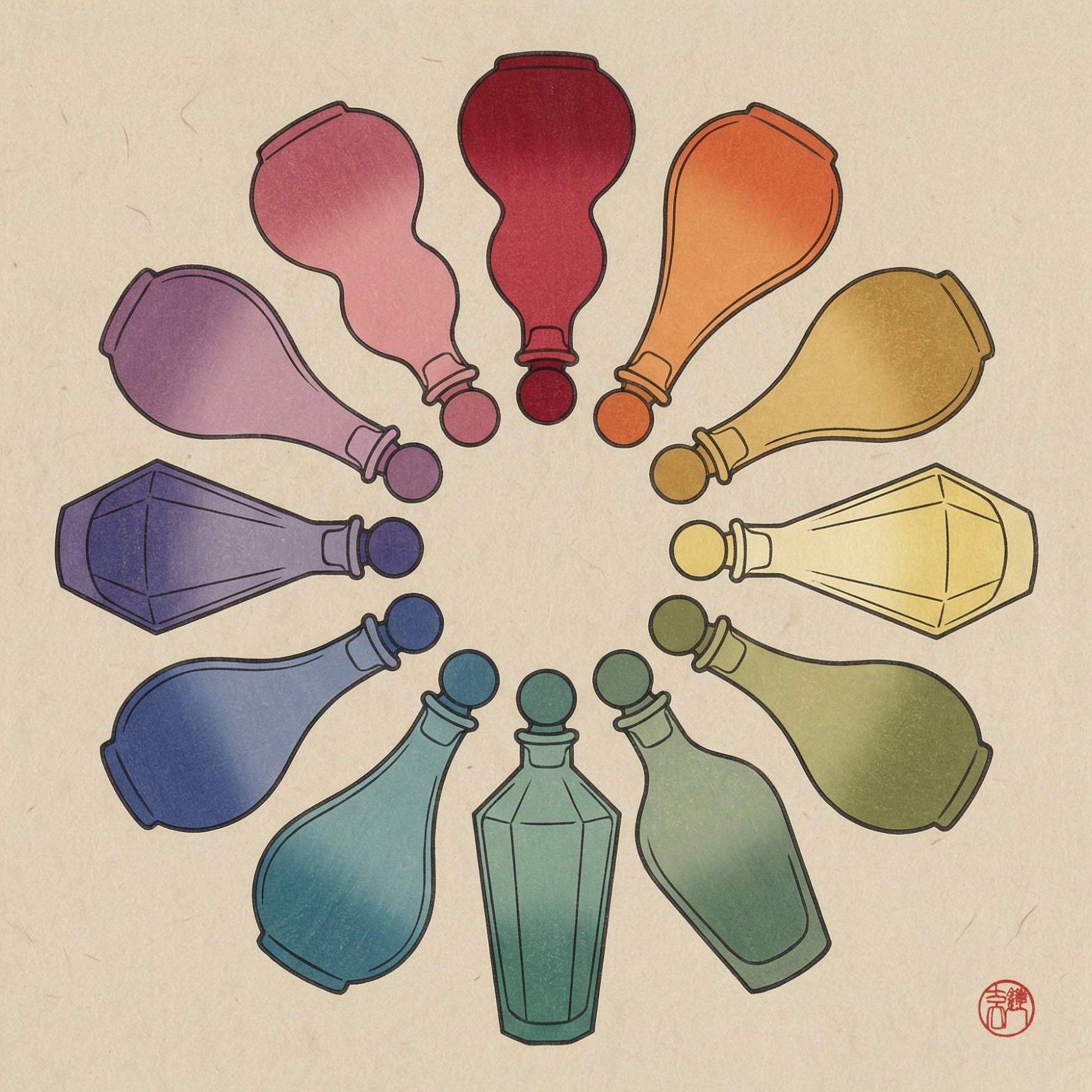
The fragrance world loves abstract descriptions. You’re just as likely to be told a perfume smells like “good vibes” or “high crimes and misdemeanors” as you are “coconut” or “leather”.
This happens for multiple reasons, some good, some bad. It’s great for marketing, as any “real” smell description has a chance of turning of a given buyer. Maybe you don’t like “maple syrup” but “a cozy morning in a forest cabin” could appeal to almost anyone. But it also solves the real problem that smell is hard to describe. Both because the average smeller doesn’t have a deep vocabulary of scent terms (in my humble opinion the world would be a better place if everyone learned what sesquiterpenes are), but also because some smell principals have no natural, or common points of reference–even if you know what ambergris is, you have likely never stumbled upon a lump of it on the beach.
But what abstract vibe descriptions don’t give us is any help trying to categorize or group fragrances together. To solve that problem many perfumers over the years have developed taxonomy systems.
One of the earliest attempts at this was Paul Jellinek’s “Odor Effects Diagram”. Dated to 1949, Jellinek’s main idea was to classify scents not based on what makes them up, but by what they “do”. What’s important about animalic and musk scents isn’t that they contain animalic or musky ingredients, it’s that they allegedly make you horny (thus they are “erogenous”). Similarly floral and balsamic fragrances make you sleepy, so they’re “narcotic”, and so on. While on some level this doesn’t seem to do much better than “good vibes” (or “sexy vibes” and “sleepy vibes” respectively) it shares a lot with the modern way Spotify organizes playlists: it doesn’t matter if the genre is classical or pop, what matters if it’s “music to party to” or “beats to study/relax to”. While I don’t think this system solves a lot of problems, it definitely gives us plenty of vocabulary to play with, and I think there’s some merit to considering what the goal or function of a fragrance is.
In 1974 Haarman and Reimer of Symrise published their opus “Genealogy of Extrait Perfumes,” which soon evolved into a fragrance circle. Details on this one are scarce, but it is believed to be the first time a wheel was applied to fragrance (I guess ultimately every sensory discipline is a little jealous of wine).
In 1984 Michael Edward’s fragrance wheel was published as part of “The Fragrance Manual”; the earliest on our list that has had real staying power, Edward’s wheel groups scents into four main families (Floral, Amber, Woody and Fresh) and a number of subfamilies. One of the delights of the fragrance wheel is how scents are positioned relatively. It’s easy to imagine fresh scents that are both floral and woody, and so fresh aptly sits between those two. Similarly woods can range from ambery to fresh, so it’s two neighbors seem natural.
A few years later in 1990 we get a taxonomy from Société Française des Parfumeurs. The taxonomy opts for 7 categories: citrus, floral, fougere, chypre, woody, amber and leather (again with a number of subfamilies). There’s clearly a lot of overlap with Edward’s fragrance wheel, though notably some of the taxonomy categories are clearly “constructions”–no single ingredient smells like a fougere or chypre, as these are definitionally comprised of multiple distinct scents.
To round out our list we have PerfumersWorld ABCs, developed in the late 1990s. This one ramps up the detail, and is quite ambitious in doing so. Each letter of the alphabet gets it’s own note, and generally tend from top notes at the beginning to base notes at the end. Some categories stretch a bit to fit the premise (cooling mint and camphor are labelled B iceBerg, while musks are simply called X-rated for X), but overall it’s impressive how comprehensively the system captures smell, and how tidily it presents it. Compared to the Taxonomy, the ABCs are very focused on individual ingredients, and are more aimed as perfumers and others in the industry than the casual perfume consumer.
As George Box said “All models are wrong, some are useful” and in picking a fragrance taxonomy you’re picking a set of tradeoffs. The ABCs are detailed, but cumbersome to explain to a layperson. The Odor Effects Diagram is intuitive, but not very instructive.
For me, Michael Edward’s Fragrance Wheel strikes a nice balance between comprehensiveness and usability. Especially if you employ subfamilies and are willing to label a scent with a primary and secondary family, you get pretty close to being able to locate almost any perfumes in the scent landscape.
Of course any system will have challenges adapting to changing reality; the Fragrance Wheel was formalized before the real dawn of aquatic fragrances, and while it’s not a particularly hard stretch to label aquatic notes “fresh”, it’s always going to be a bit of a moving target.
We’ve chosen to use the Fragrance Wheel to categorize our reviews on Perfume Notes, and for that reason we’re including the tabular version we use below:
| Primary Family | Subfamily | Key Characteristics & Notes |
|---|---|---|
| Floral | Floral | Fresh-cut flowers: Rose, Jasmine, Lily of the Valley. |
| Soft Floral | Aldehydes and powdery notes; iris and musk. | |
| Floral Amber | Orange blossom and sweet spices. | |
| Amber (Oriental) | Soft Amber | Incense, amber, and warm resins. |
| Amber | Sensual blends of resins, vanilla, and exotic spices. | |
| Woody Amber | Spicy amber notes woven with patchouli or sandalwood. | |
| Woody | Woods | Mainstream aromatic woods like cedar and vetiver. |
| Mossy Woods | Traditional “Chypre” scents; oakmoss and amber. | |
| Dry Woods | Smoky, leathery notes and dry woods like tobacco. | |
| Aromatic Fougère* | Lavender, geranium, and herbal notes (the “universal” family). | |
| Fresh | Citrus | Zesty notes of bergamot, lemon, and mandarin. |
| Water | Marine, aquatic, and ozonic notes (sea breeze). | |
| Green | Fresh-cut grass, violet leaves, and pine needles. | |
| Fruity | Berries, apples, pears, and tropical fruits. |